

Classics You Don’t Improve: Barbour at Poszetka
We love creating our own designs and putting our twist on the classics, turning them into the Everyday Classics that carry the Poszetka spirit. But we can also admit that some pieces are already perfect as they are - no improvements needed. That's why, for the first time, we're proud to introduce Barbour at Poszetka.
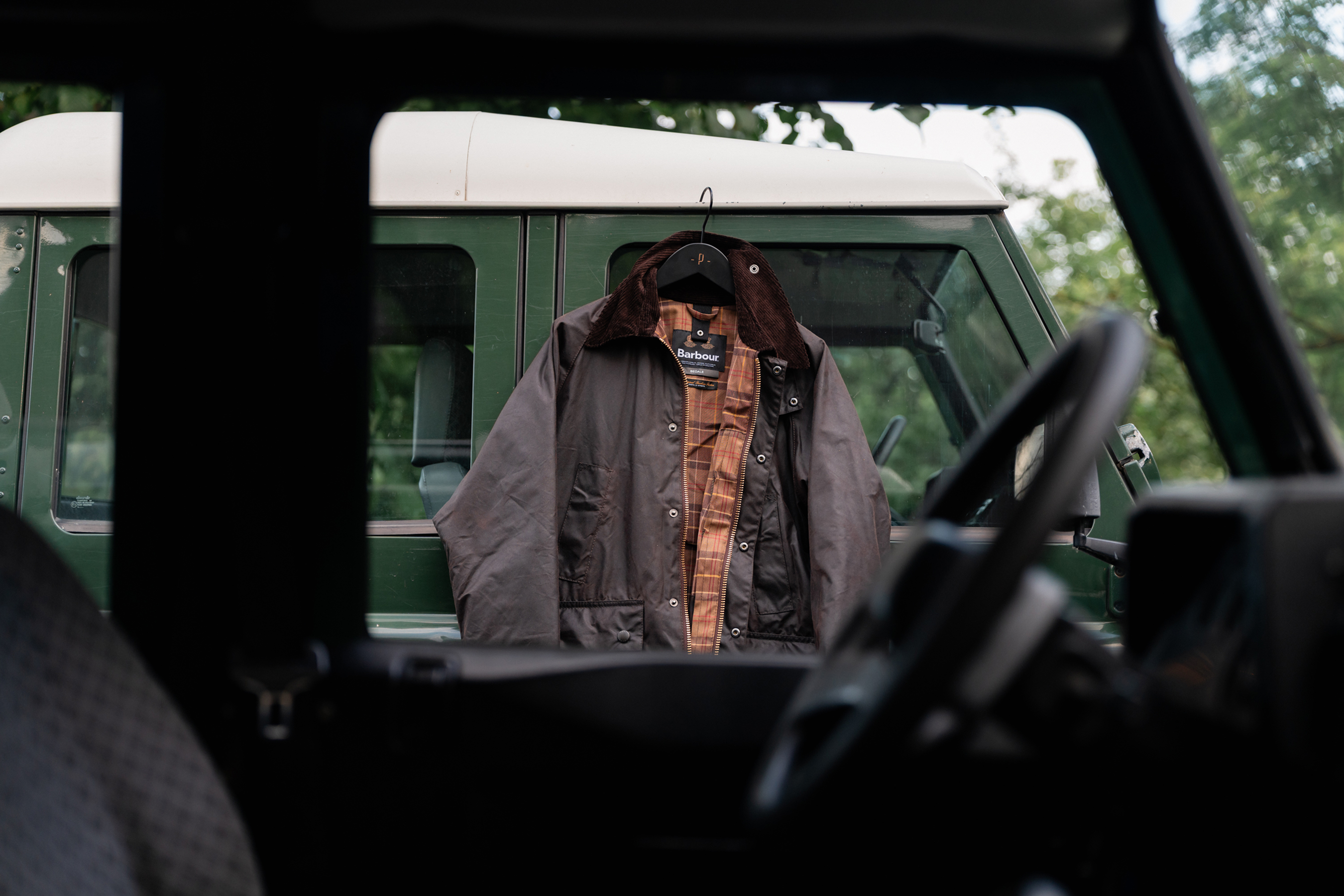
Heavy, oily, waxed cotton. Corduroy collar. Tartan lining. A roomy cut. Big flap pockets. And a full palette of earthy tones — muted, matte, spanning between brown, green and black. A true classic, isn’t it?

This archetype has long been ingrained in our minds as a staple of British Country style. Waxed cotton jackets seem as though they’ve looked like this forever, really. You’ll spot them in countless photographs of the British royal family over the past half-century — on Queen Elizabeth, Prince Philip, Princess Diana, and Prince Charles, even after he became King — not to mention The Crown series, which has already been named as one of the reasons why in the last few years the brand’s fame became even bigger.
And while it might surprise you how young some of the so-called “most classic” models actually are (more on that in a moment), we’ll admit — we couldn’t have done it better ourselves.


The story of Barbour spans a little over 130 years and five generations of the Barbour family — who, notably, still own and manage the company. In a world of luxury brand consolidation, that’s quite an achievement.
It all began in 1894, with… workwear, you could say — functional clothing made for people of the sea: fishermen, sailors, and all those who had to face the harsh, wet, and windy British winters.
By the 1930s, the brand had ventured into motorcycle clothing — an important chapter that gave rise to Barbour International. Under that sublabel, the company even produced suits for submarine crews during World War II. From those, the belted four-pocket jackets evolved — the ones we instantly recognize today with this name.

 Źródło: archivalblog.com
In the postwar decades, Barbour’s offering gradually shifted from pure utility toward country sportswear — designed for horse riding, hunting, and outdoor pursuits of the British upper class, including the aforementioned aristocracy. It was still workwear in some way, but serving a different purpose for a different group.
The brand’s status was officially sealed in 1974, when Barbour received its first Royal Warrant, granted by Prince Philip, Duke of Edinburgh. Two more followed — from Queen Elizabeth in 1982, and from Prince Charles in 1987 — marking the brand as an official outfitter to the royal family.
Interestingly, those Royal Warrants also serve as a kind of historical marker — you can roughly date a Barbour jacket by checking which ones are printed on its label. Though the brand never had its royal standing taken, the warrants expired one by one with the passing of their patrons. Philip’s in 2021, Elizabeth’s in 2022, and Charles’s upon becoming King — which automatically annulled the one he had granted as Prince of Wales. Fortunately, starting May 2024, Barbour once again proudly holds the most prestigious designation: Royal Warrant By Appointment to His Majesty The King.
Our jackets feature a mix of labels, depending on the precise date of production of each piece — some with the former royal crests, some without, and some already bearing the new one.
A special thanks to Mateusz from the But w Butonierce association for inspiring me to look this up during our 15th-anniversary event in Katowice — cheers!


Alongside them, there’s also the Ashby, a more contemporary, slimmer reinterpretation of the classic waxed jacket — in a slightly more “urban” palette. But we’ll save that story for another time.
The Beaufort is the longer, fuller model, extending past the hips — perfect for wearing over a tailored jacket. The Bedale, originally designed for horse riding, finishes higher, around the seat line. On shorter frames (like mine), it’s still long enough to be worn over sportcoat; on taller ones, it works better as a casual, everyday jacket thrown over a sweater or overshirt.


We put both to the test with Tomek during our visit to Kamil Barczentewicz’s vineyard in Dobre. Despite the calendar still showing summer, the weather was pure November — rain, wind, clouds. Ideal conditions for testing waxed cotton!
Having done that, we have to say that forty years later, this design still works — and performs brilliantly.
Because some things simply don’t need improving.


