

Tough, Not Tweed
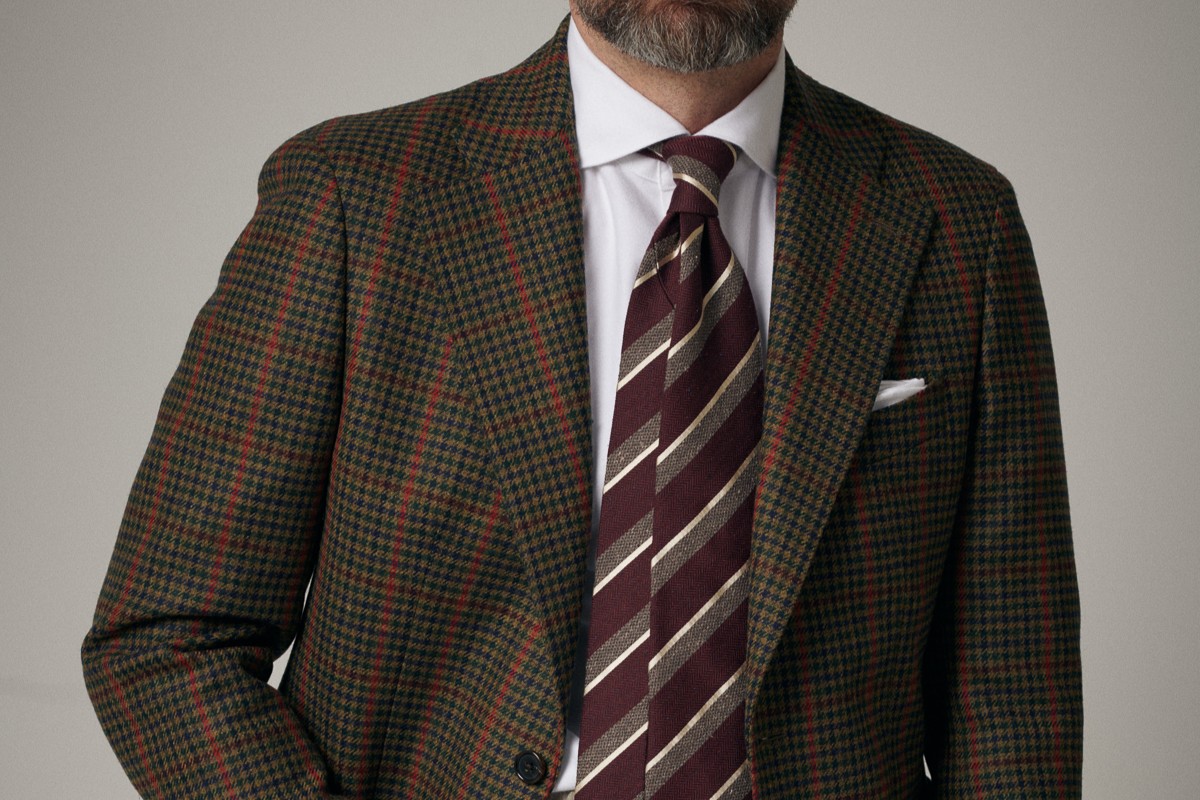
There is no shortage of tweed in our autumn–winter collection - but not every heavy winter wool is a tweed, and not all non-tweeds are delicate Italian fabrics either!
We have our firm favourites - fabrics we return to time and again. Sometimes every season, sometimes after a break; but for sure we appreciate a good Donegal Tweed, Harris Tweed, or simply a solid other tweed. At the opposite end of the spectrum are Italian options - much loved by Tomek, who tends to run hot - offering almost as nuanced texture without the hefty weight and coarseness. One such example is Bottoli’s Knickerbocker Tweed: an Italian alternative roughly one third lighter than the fabrics woven in north-western Ireland.
And then there is a third group of materials - one harder to find, and one that isn’t quite as easy to be summed up with a single, clever label.

We tend to call jackets like this: tough, not tweed.
Attempts to guess what the fabric actually is tend to vary depending on distance. From afar, the colour palette - heavily referencing British Country style - makes it easy to be misled and exclaim, “tweed!”. Up close, and especially to the touch, that diagnosis quickly proves incorrect. A light brush of the surface may suggest something relatively lightweight; but once you take the fabric in hand, or lift the entire jacket, that impression disappears. The cloth turns out to be dense, smooth, soft, and heavy, all at once.
And in its full expression, unmistakably British.

The secret lies in how the wool was woven - or rather, how it was spinned into yarn beforehand. Technically speaking, this is worsted wool. Yes, the same category used for elegant suitings - though in this case thicker, and spun from fibres that are not quite as fine. Still, they are long and even, twisted together to create a smooth surface.
Tweed (and most flannels), by contrast, is made from non-worsted - woollen - yarn. This is spun from shorter fibres, which tend to lie less evenly and protrude more, creating a fuzzy surface. While the degree of coarseness may vary depending on finishing and sheep breed, the common denominator is a hairier, more matte texture.

Earlier we mentioned the “Britishness” of this solution. We phrase it this way because only the British seem capable of taking yarn that is theoretically refined and elegant, and turning it into a fabric built for harsh conditions. Italians would more likely do it other way around - taking woolen yarns and trying to make something light out of them. Which, incidentally, they do very successfully; our jacket made from undyed wool is a perfect example.
Both approaches have their charm - and we do like both, as we’ve always enjoyed blending North and South - but the former is far less obvious. It represents a different answer to the question: “how do you turn a country-style jacket into a city-ready one?”. While in the latest issue of Everyday Classic magazine I reflected on what makes a tweed jacket feel contemporary - focusing on colour, cut, and details - the British, decades ago, decided to start with texture. To create urban tweed, they effectively had to invent a non-tweed: a fabric that looks like tweed, but isn’t one.


So who are jackets made from such fabrics for today?
Firstly, for those for whom traditional tweed is simply too coarse - whether due to considerations of formality or personal sensitivity to texture.
Secondly, for those who find Italian alternatives lacking in substantial weight, and who need something more robust - whether for thermal comfort or for the way a jacket should drape and sit on the body. After all, the heavier the fabric, the easier it is to achieve a relaxed yet well-balanced fit.
And thirdly, for those who simply enjoy fabrics with a slightly old-school character - very different from today’s mainstream retail offering, yet when cut in a modern way, no longer archaic at all, but still serious.


I can also add that even Tomek - a devoted advocate of lighter fabrics - has grown fond of it. Less typical jackets like this tend to convince best up close, when everything described can be read through touch and fitting.
So the best thing to do is simply to try it for yourself - perhaps such winter ready*, tough, not tweed* jacket will become your seasonal favourite.