

The Black Suit, Reconsidered: a Sign of Times?
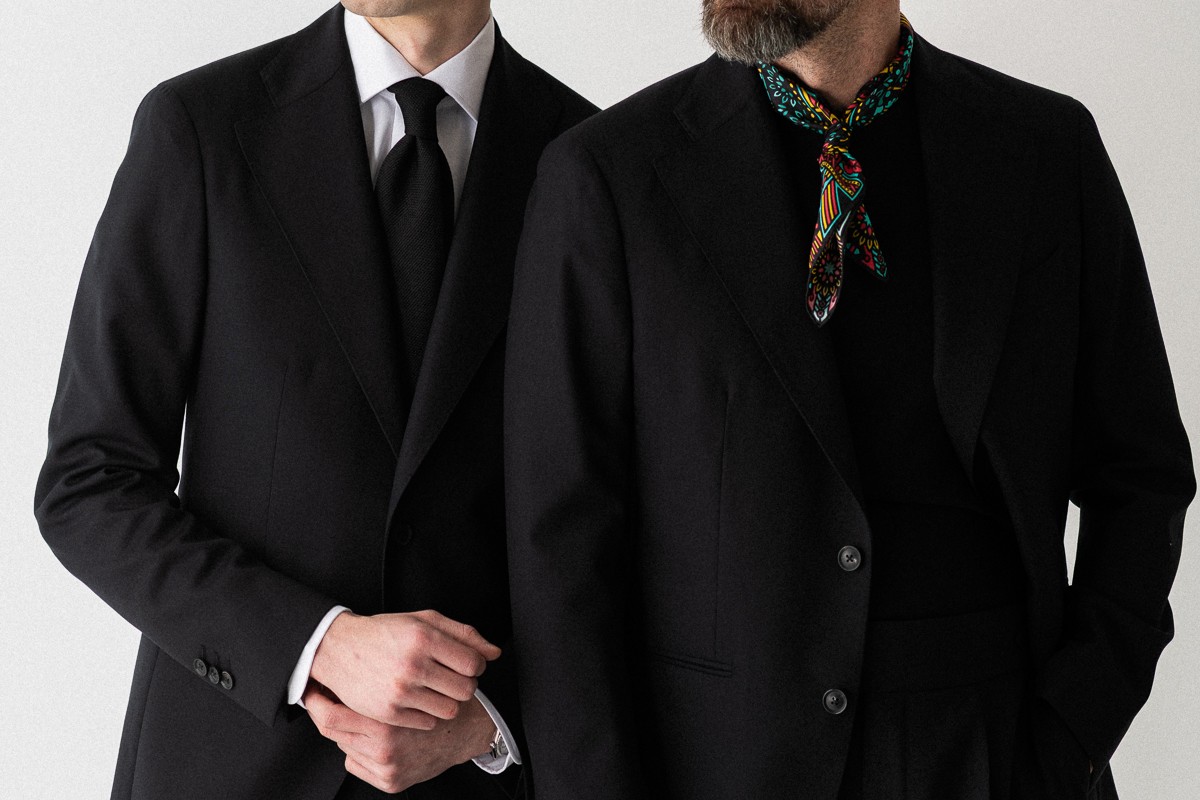
It only took Poszetka 15 years to finally make a black suit.
Such an opening may sound a little ironic, but indeed - this is the kind of product that perfectly illustrates the transformation we’ve witnessed with our own eyes. The evolution of the market, of the menswear rules, of the common beliefs - happening over the past decade and a half, in parallel with the history of our brand.
How is it that not so long ago we were being warned against wearing black, and now such a suit joins our Classics series - in a brand that is, by all accounts, very classic?
It’s not easy to answer shortly, so let’s start at the beginning.

Some claim that classic menswear is not fashion. “Yes, but…” one might reply. It’s not that nothing changes. Details such as the width of lapels or trouser legs shift constantly - remember not so long ago when skinny lapels and trousers dominated? Then there are geographical influences shaping aesthetics of the time - British Country, Italian sprezzatura, American Ivy all coexist, but with each waxing and waning in impact. And finally, there’s color.
Fifteen years ago, we stood at the threshold of a renaissance of classic menswear. Fashion blogs were sprouting like oases in a desert of style - in Poland it happened a little later than in the US or the UK, but they found a fertile ground in a country of poorly dressed men, surrounded by 1990s suits that were shiny, polyester, and much too big. There was much to discover. Much to learn. Much to change!
One of the symbols of that transformation - at least here - was the navy suit. Brought back from oblivion - believe it or not, while today it feels obvious, back then it was hard to come by - it went on to make a career as the most versatile suit. Many began their journey there.


The truth is, it really works for a lot of men. It works day and night. On blondes and brunettes. On grooms and wedding guests. Graduates and politicians.
So the belief arose that there was no better option.
But as is often the case with categorical advice, the baby was thrown out with the bathwater: the once-popular black suit was pushed aside, labeled as clothing only for priests, mourners, and the Men in Black. At best, it came with an asterisk: maybe acceptable as evening wear. That stigma left it in decline.
Yet, as reality tends to be, things are more nuanced. The black suit does make sense - well beyond those narrow contexts!

Black is, simply put, another color. From a physics perspective, not exactly a color - rather, the absence of light - but from a menswear perspective, it surely is. Think of it as just a shade darker than charcoal, the final stop in the tonal spectrum of greys stretching from white. Not far from the mythical midnight blue, only stripped of saturation. The darkest shade. Very simple, really.
And it is precisely this simplicity that has made black both very chic and very boring. It became the uniform of many artists, architects, and designers. At once refined and utterly devoid of refinement - depending on one’s view. It got bad press as the color of “no idea,” but also earned its rightful place in the pantheon of elegance as the most formal, most beautiful shade.
This duality made it hard to view black neutrally. The color always carried a message, shifting with the times and the environment. But at its core, it remains an excellent choice for minimalists… and not only them, one might add.
With one caveat: black must be right. To serve as a good, clean, minimalist backdrop, it must be matte. Deep. Without the glossy sheen that gave rise to the saying that it looks best under artificial light.


And since we’re talking myths - what about the idea that black “drains” color from one’s face?
If someone is tanned or has a darker complexion - just look at Tomek’s outfit! - it’s not an issue. If someone is fair-skinned and blonde - like yours truly - simply break it up with a light element close to the face: a white shirt or a colorful scarf/bandana. The contrast will help.


Alright then, what is the role of the black suit today? Where, when, and with what to wear it?
Think of it this way: compared with the “classic,” business-oriented navy or grey, black works better at both ends of the spectrum. It’s easier to reach for in the most formal contexts - and in the least formal ones that might not seem obvious at first.


With a knitted T-shirt, in an urban, not-too-summery version (when linen is out), black is great. It has the x factor: a touch of rebellion, stylish contrast, a hint of mystery. Especially in the matte version we’ve already mentioned.
If you’ve ever heard of high-low dressing - blending traditionally formal elements into casual outfits - this is a perfect, easy-to-apply example. A classic suit can serve as a minimalist backdrop not for a shirt and tie, but for a simple T-shirt, maybe with a scarf at the neck, maybe sneakers instead of loafers.
Alternatively, it works beautifully with non-business shirts, worn open at the neck (perhaps one button lower than usual): cowboy shirts (especially in light denim or colorful fabrics), summer popovers, workshirts with interesting textures.

At the other extreme, black excels in highly formal contexts: with a white shirt and a very dark - or conversely, very light, say champagne-colored - tie. Add a white pocket square, highly polished black shoes, and voila, an elegant ensemble for a serious ceremony.
Perfect for an evening ball or even daytime celebration (with the lighter tie, definitely!), as long as you’re not spending the whole summer afternoon in blazing sun - it’s better suited to the naturally darker seasons, or days spent mostly indoors.

And what about wearing a black suit with a bow tie? Yes, you can. I’d suggest one in grenadine rather than smooth silk, to avoid resembling a tuxedo too much. Still, if the event calls for black tie, it’s worth sticking to the dress code - unless it comes with “optional” or “creative,” in which case the black suit works wonderfully.

The black suit is still a classic suit - simple, minimalist, appropriately elegant - but a less obvious one. It stands out in a sea of navy and grey, yet remains discreet, since neither its color nor fabric shouts from afar. A perfect canvas for those who want to add something of their own.
A classic. Simply a Classic.