

If We Had To Choose Just One Coat…
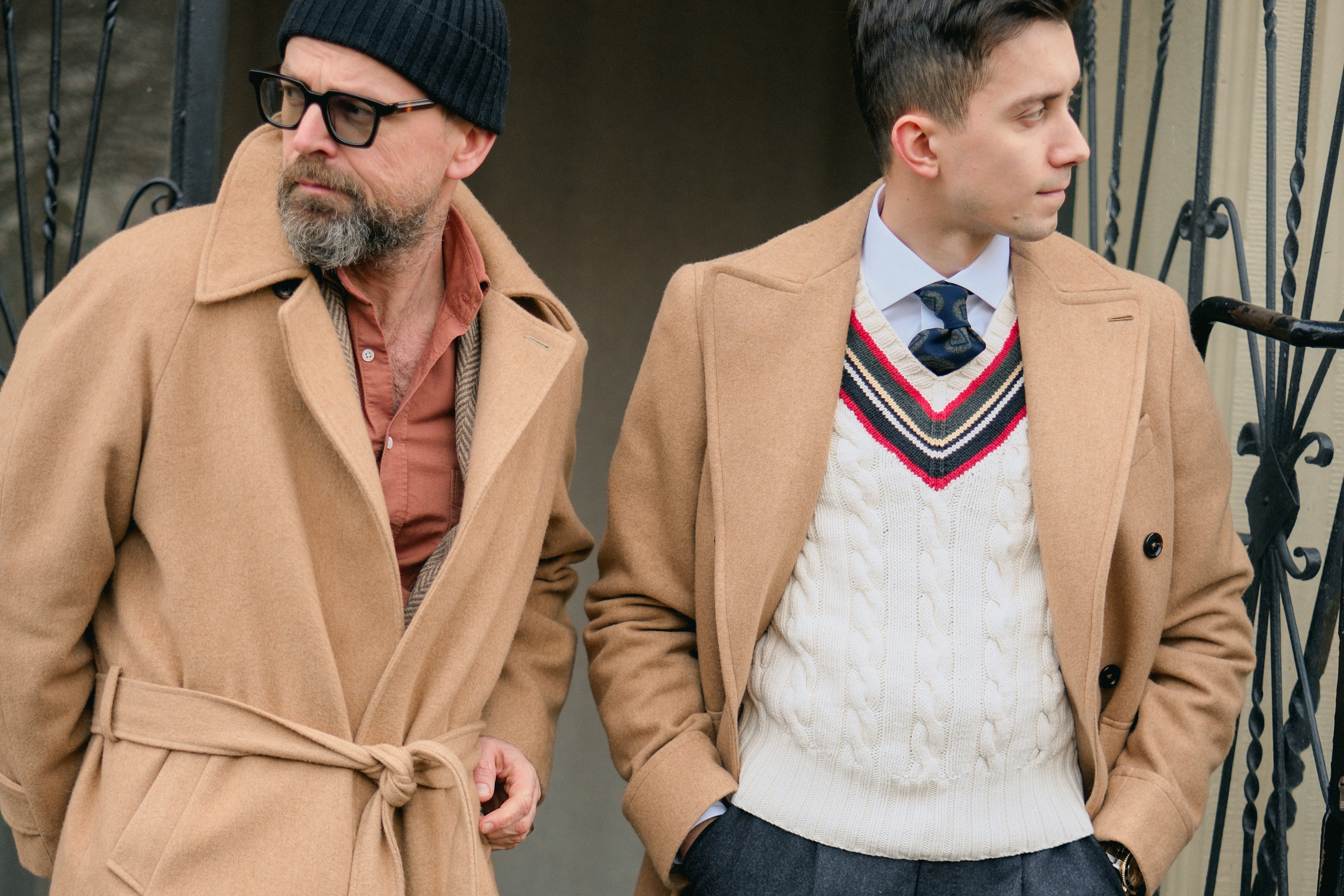
…each of us would probably cut it in our own way, but from the same fabric. Ladies and Gentlemen, here comes the grand return — and a swift farewell — of the caravan of camel coats at Poszetka!
If you follow our Instagram, you may have already seen a teaser of a certain exceptional fabric that found its way into our hands — found its way quite luckily, one might add. Even though we live in times when most things are readily available (price being the only remaining question), there are still materials that you come across only rarely.

And although camel wool neither enjoys the semi-divine status of vicuña, nor is it as pop-culturally associated with softness, nobility, and high price as cashmere, I would venture to say that in some respects it actually stands above both.
There are, after all, things that — if not made from it — are simply not the same; they are not quite it. A camel coat is a category and a reference in its own right — something that enjoys cult status in our world.
It is associated not only with a particular hand feel, but also with a specific colour, and even a specific cut — or rather, many cuts under one umbrella term, as not every polo coat is the same. But more on that in a moment.


First, the fabric itself.
A few years ago, I already wrote a piece on camel wool — “As Soft as a Camel Hair Jacket” — covering the absolute basics, praising its qualities and excellent thermal insulation, and mentioning its rarity and limited colour range*, which give it its distinctive character.
Back then, however, my enthusiasm focused on a camel wool sportcoat — I had a new MTM commission myself; the same fabric also appeared in our FW2022 collection. That was merely an introduction, a lightweight option. Coats were only mentioned in passing, with a promise to return to the subject on a better occasion.
And in truth, coats are where one should start — because from a technical point of view, this fabric seems made precisely for them.
*It is worth adding something I did not mention back then — this is influenced not only by limited supply, but also by the fact that camel hair is very difficult to bleach, and therefore equally difficult to dye into anything other than very dark and/or intense colours.


Of course, you can make a heavy coating from any wool — but not every wool will be equally warm at the same weight. And not every wool will do so with the same style!
Camel hair has a specific structure: hollow spaces visible in cross-section create a natural insulating barrier (think of the walls of a thermos). Additionally, the individual fibres are quite long and fine, which allows them to be densely spun together, creating a fabric that is more compact and less breathable than, for example, woollen tweed.
The result is a rare combination of warmth, wind resistance, a degree of water resistance — and a texture that is genuinely pleasant to the touch. It practically invites you to wrap yourself in it.

If you think about it, such an instinctive form of outerwear predates tailoring altogether: blankets, throws and ponchos, also made from camel wool in certain cultures, have existed for centuries. The earliest polo coats weren’t much different if we are to think about it.
According to the well-known story, the style emerged in the late 19th century, when British polo players would throw on belted, robe-like coats during breaks to keep warm. Polo being an elite sport at the time — requiring horses, leisure and means — the use of expensive camel wool (remember, there were no camels on British Isles, but plenty sheep) was hardly an issue, and certainly a welcome comfort.
As with many style ideas born in Anglo-Saxon culture, the polo coat eventually crossed the Atlantic and became part of Ivy League dress. Much like the button-down collar — which, incidentally, comes from the very same sport — it was popularised by Brooks Brothers in the 1920s.


Although as late as the early 1980s you could still see a belted, robe-like coat worn by Richard Gere in American Gigolo — designed, incidentally, like all the film’s costumes, by Giorgio Armani himself — the cut evolved over time and grew closer to more conservative coat styles.
The polo coat archetype gained buttons and lost the belt; a breast pocket appeared (sometimes even with a flap), turn-back cuffs and other details followed. Today, the most common versions feature a 6×3 or 6×2 buttoning, similar to an Ulster coat, though without the characteristic half-belt and back pleat. Patch pockets, however, remain essential.

No one on our team opted for a fully conservative version.
From the fabric mentioned at the beginning — weighing 750 g per running metre, woven from 100% camel wool by Joshua Ellis — in addition to a few thoroughly classic MTO coats for our customers, several creations for the Poszetka team were made (or are currently being made).
Tomek — and I, Mateusz — went for a raglan coat. A raglan that is surprisingly close to the original archetypes, albeit in a version with jetted pockets!

Paweł chose a variant that looks fairly straightforward from the front — but a glance at the back reveals details typical of Ulster coats. A sort of “polo coat with a twist”.
More team pieces are still in the making. Our enthusiasm for camel wool is no coincidence — almost all of us have fallen for it.

We’ll admit this much: it’s partly our fault. The entire bolt of fabric disappeared at remarkable speed. As I write this, there may be only two or three remaining slots for a coat made from this cloth.
If you’re interested, feel free to reach out at katowice@poszetka.com — perhaps the very last piece from this special edition is still waiting for you?