

From Brittany to Baltic: French Workwear, the Poszetka Way
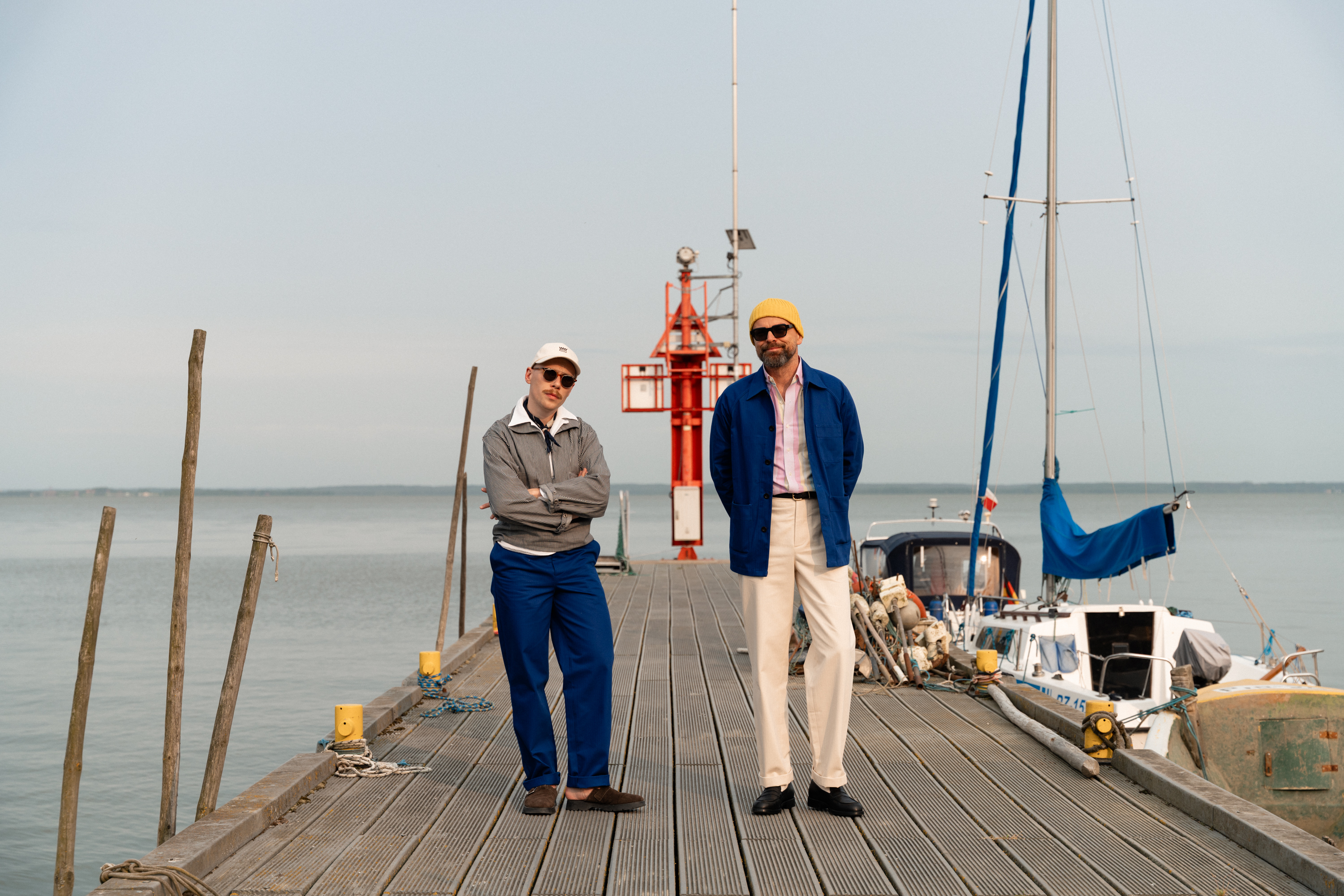

To be honest, it’s a style most of you have already come across… though not necessarily under that name.
Well — let’s take the popular nautical style as an example. One of the first associations? Horizontal striped T-shirts and longsleeves — Breton stripes.


It’s no coincidence that we start with that classic knitwear — it’s a very good starting point both for today’s story and for one’s wardrobe expansion, before it starts featuring less obvious pieces.
It’s a bridge between two worlds. Through its maritime associations it obviously goes well with more “nautical” pieces — like a blazer — but also with more “workwear” garments, which brings us closer to what we’re focusing on today.
These categories naturally merge and overlap. And French workwear — even though “workwear” by the name — is in fact an aesthetic very close to the more classical side of menswear.

We follow the trace of the colours — white and blue. A very simple palette, valid both on land and at sea — and both in the “low” and the “high” registers of clothing!
Today we know this as a refined and elegant combination, something that many associate more with a yacht marina than a fishing pier… yet it, too, has a truly utilitarian foundation, deriving from how garments used to be dyed.

Back in the day — and we’re talking about the times up to the first half of the 19th century, so not exactly ancient history — not all colours were created equal. Synthetic dyes did not yet exist; to achieve a desired tone you needed a dye extracted from plants… or animals. Some were easier to source, such as yellows and browns (earth tones could be obtained from many sources), and some were much harder, like Tyrian purple extracted from sea snails, reserved only for the wealthiest for hundreds of years.
Paradoxically, true indigo, extracted from Indigofera plants (and actually lighter than the deep denim blue we know) was also expensive, because it had to be imported from India. In Europe people commonly used woad, which produced a lighter, less “noble” shade — and eventually alternatives emerged. In the 18th century, the first synthetic dye was invented — Prussian blue, producing a deeply saturated shade (often referred to as French Blue). By the end of the 19th century, synthetic indigo was already known as well.
Suddenly, blue and navy became an ideal choice for uniforms and workwear — large quantities of fabric could be dyed cheaply, the colour effectively hid dirt, and in its lighter, more saturated version it was highly visible — something actually desirable in certain professions, and not disqualifying even on the battlefield (since these were not yet the days of camouflage). Price and availability were the main factors.

In France, the term bleu de travail — literally “blue for work” — was coined and is still used today to describe the characteristic blue jackets and trousers that existed in many cuts and shades, born as simple and durable garments designed for work. To this day, this is the pillar of the French version of workwear.
On a side note, it’s worth recalling the origin of the term blue collar — the prevalence of this colour, often in form of a chambray fabric used for shirts, known for combining durability with breathability (interestingly, also originally a French invention!), became so emblematic of early-20th-century workwear that it gave birth to the term that still designates manual labour today.


And what about white, off-white and cream?
Well — even cheaper than using a cheap dye was… not dyeing the fabric at all. Ususally not even bleaching it — hence light, greyish beiges, the natural colours of linen and cotton. On one hand, these fabrics dirtied more easily; on the other hand, they could be washed and treated aggressively without the risk of damaging the colour — which made them extremely practical.
That wasn’t unique to France — but naturally, these tones appeared there as well.

Pure, optical white, however, was harder to achieve — requiring better-quality yarns and additional bleaching — which is why it was reserved to more affluent people and often worn by those who needed to distinguish themselves from manual workers. And yes — that is precisely how the term white collar came into being.


Style, however, is not only about colours but also about silhouettes — and actually, the combination of the two.
As usual with the Working Class series, we had to dig a bit deeper. We went looking for more casual, everyday alternatives to jackets and other pieces that could complete a summer — and not only summer — wardrobe.

And with workwear, of course, we’re talking overshirts of all kinds — sometimes closer to a shirt-jacket, sometimes more to a light work jacket or a chore coat.
Three roomy front pockets, placed like on a sportcoat; a spread collar; proper bottom-covering length — such cuts have appeared at Poszetka many times, an absolute classic that runs through many styles. This time it simply had to be made in a saturated blue shade, a nod to the origins.


To go with it — although not as a uniform, as the idea was about something that works separately — trousers in the same fabric and colour, a true French classic. In a way, a summer alternative to jeans and chinos — combining a comfortable cut with a more vibrant, seasonal colour.
Naturally made from a sturdy HBT (herringbone twill) cotton — a fabric that became a worldwide workhorse in the 20th century, from France to the USA and Japan.


And then something slightly less typical — the smock. A kind of “heavier popover”, you could say; a cross between a popover and an overshirt. An ancient pullover? A lightweight jacket you pull over your head?
I’m glad we brought this shape back — it still feels very relevant. Those unusual accents — like internal pockets or a concealed button placket, which used to protect garments during work (for example when handling fishing nets) — are now those little details that make the form visually interesting. Same goes for button-down collars on shirts, or the gun flap on a trench coat. Function created form — and now the form stands on its own.


Since we brought up the popover — I have to mention the not-so-French (or maybe…?) popover that also made its way into this collection.
It’s not directly derived from the French workwear style, but fits well and absolutely works in this context. Camp collar with no stand, a practical chest pocket, relaxed fit and a longer front placket — all of this picks up elements of the smock and translates them into a lighter, more shirt-like version. Even the crinkled cotton texture blends naturally complements the range.

Is that everything? Of course not; French workwear — like many topics in the menswear world — is something you can dive into very deeply. We’ve extracted what’s easy to grasp the first time — and what’s easy to wear casually, on daily basis.
We’ll likely return to other elements and related topics at another time, but before we say goodbye, I’d like to take you one more place — away from the Baltic sea — where we found some rather unexpected connections…


We stop a few hundred kilometres away from the coast, near Kazimierz Dolny, in the village of Dobre — where we recently visited Kamil Barczentewicz.
During the interview and photo session, Kamil somewhat accidentally dressed in typical French colours — which is meaningful, considering his wines (including the pride of the winery, Pinot Noir!) clearly reference France in terms of style. Burgundy connections appear both in the style of the winery and the style of the winemaker himself, as you can see.


As Kamil himself says, he really likes this shade of blue — and the outfit in the photos is something he’d gladly wear while hosting guests, because it suits the environment and he feels comfortable in it. More relaxed than a jacket, yet several steps above literal workwear.
And that, by the way, is a perfect example of someone who fits this style not only in terms of colour and cuts, but also in spirit — exactly the idea behind the WWCCC label. What Kamil does on a daily basis definitely isn’t a typical “office” job. On the other hand, aesthetics clearly matter to him (just look at his label designs!), and even when he wants to look good, he reaches for more casual pieces.


Incidentally, just after the maritime references, we’d probably put winemaking in second place in terms of importance for French workwear. Many of the still-existing family companies producing traditional garments in these colours and cuts were suppliers for winemakers (for example Le Labourer), and today often run two separate lines — a technical one that’s still literal workwear and a heritage one, based off traditional designs, that serves as a brand’s fashion line.
We do it our own way — we have the tailored, sartorial Poszetka and the everyday, casual Working Class.
And these two worlds meet somewhere in the middle, connected not only by a shared colour palette. Not only by nautical style.


So… where will the Working Class label go next?
In autumn and winter it will once again be time for heavier fabrics, darker tones, and pieces closer to the city than the beach. Again inspired by the past; again drawing from historical workwear, but reinterpreted in a fully contemporary way.
I can’t reveal too much yet – but I can say that this time, we travelled much closer than France to find inspiration… and it may be quite a surprise. Stay tuned. More news are coming really soon!
PS For those who prefer videos over text: you’ll find a companion to this post on Instagram, on the @mateusztryjanowski profile – we recorded a studio series in which I talk about each piece and the inspirations behind it. Come back for more in the next few weeks!