

Everyday Classic Magazine: Jan Kallwejt (Preview)
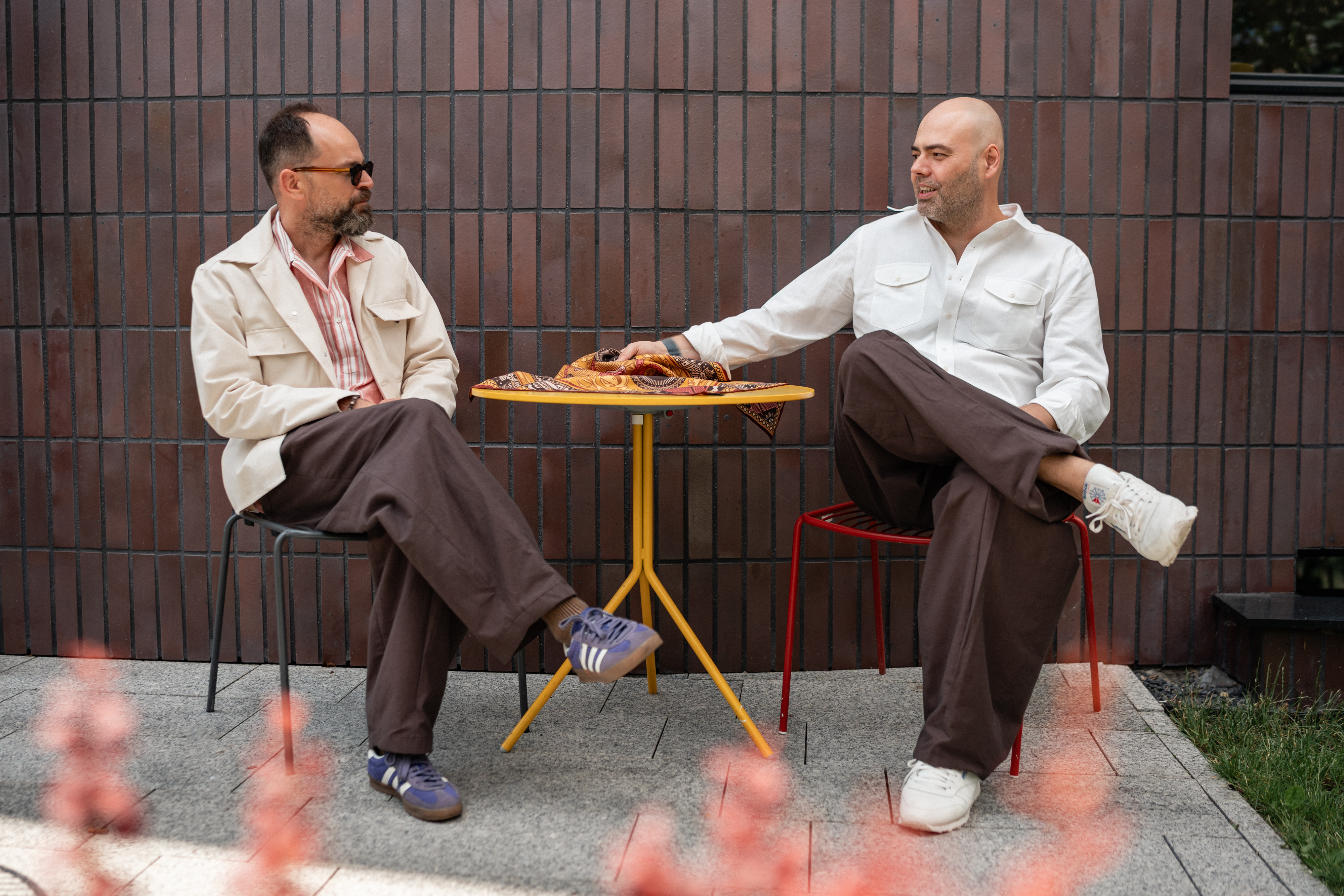
The 15th anniversary we’re celebrating this year isn’t just about limited products, a bigger new space in Katowice, and unique collaborations that we’ll be unveiling in the coming months — it also comes with a special edition of the Everyday Classic magazine! We’ve invited old friends, clients, and collaborators to contribute, and their presence will make this issue truly special.
The release is due in September - until then, we'll gradually be revealing the pages, table of contents, and guest list. To kick things off, we invite you to read an excerpt from Tomek's conversation with Jan Kallwejt, the creator of legendary pocket squares (including best-selling "Polska") and the designer of the "15" visual identity.
If you'd like to read the entire interview, we encourage you to pre-order the print edition - available here.

Tomek: It would be hard to calculate exactly how many “Poland” pocket squares have ended up in our customers’ hands, but there’s no doubt it’s the most important and best-selling pocket square in Poszetka’s history. Originally, it was meant to be a one-off series, with no reissue. But people kept asking about it so much that we brought it back — and then it kept coming back again in several color variations. Was designing such a complex illustration on such a small piece of fabric difficult for you? More complex, more demanding than typical projects?
Jan: That format, even at 33 × 33 cm, never seemed small to me — and the specifics of the project allowed for a lot. It turned out that the silk printing technique can handle pretty fine lines, so the main problem I thought of was solved. Plus, I really like the square format, and over the years I’ve grown to love symmetry too — perfect! Though I admit that since this was probably my first real contact with pocket squares, it did feel a bit strange to me at first — strange that someone makes this kind of thing and sells it at such a high (as I perceived it) price. I didn’t believe it had commercial potential. But it turned out to be quite the opposite. There was a boom. I’m happy with most of the projects I’ve done. I’m sentimental about “Poland”, but I also really like “Katowice” — I did it in vibrant colors and managed to fit in lots of elements and little details.
Tomek: Is your level of satisfaction with an illustration somehow linked to how much time and effort you put into the details?
Jan: That’s a really tough question — I can’t really sum up all the hours of creative work. I don’t even try to count them. With projects like these, the end result doesn’t necessarily reflect the number of hours spent drawing. There are often lots of repetitive elements, sometimes you have to really focus on different details. But in general, pocket squares kind of “make themselves” — I sit down, get to work, and the project evolves naturally. One project takes at least a few days, but with breaks for other projects and some rest time in between.
Tomek: Do you sometimes finish a project in, let’s say, four hours, while another one takes you three full days from morning to night and still feels endless?
Jan: It really varies, but I think you have to spend at least 10 hours on each one. Even if something came together faster, I’ll still sit down again, tweak it, see if I can add more. Sometimes I reach 30 hours, especially when I’m drawing maps and want to fit in lots of elements. Or even 50 hours, if I’m working on something completely new to me — when I have to research each location, think about how to show it, and create a custom icon for it. I’m trying to change my approach a bit now because sometimes I went overboard and tried to cram in too many elements, which ended up so tiny that the final effect was inversely proportional to the amount of work. The project could have twice as many elements, but it was so dense you couldn’t really tell one from another clearly.


Tomek: Where does your iconographic — if I can call it that — style come from? It feels rooted in the web designs, reminiscent of emoticons. The style is so distinctive nowadays that I wonder — has the internet shaped it so much or was it something you developed as very much your own from the start?
Jan: As is usually the case, a style is made up of several factors. When I was younger, I worked at various agencies — interactive agencies based in Poland and Germany — and that was the early days of the internet. I also worked a lot with very limited formats, doing ads, all sorts of things for the web, which had to fit within a certain framework. I learned that, it suited me. Plus, I’ve always really liked folk art and naive painting —and both have lots of such elements, iconic and repetitive. By the way, around Katowice you had a lot of such artists too.
Tomek: Grupa Janowska [The Janowska Group], you mean?
Jan: Exactly. Painters such as Teofil Ociepka, Erwin Sówka, Paweł Wróbel... By the way, I have two of Paweł’s paintings, one of Katowice with factories, and another with rural buildings. I didn’t buy them myself — my father was a painter, my family is connected to art, and my father’s best friend, my uncle, had a gallery in Germany where he promoted many Polish artists, especially folk artists, during the communist era.
[…]

ou can find the rest of the interview in the print edition of our Everyday Classic magazine – launching in September!
